
Bergen Language Design Laboratory (BLDL) at SC26
BLDL Booth 539 at SC26.
At supercomputing in Chicago, Il, we are showcasing work on:
Green Computing
Energi efficient computing: Productive, Portable, Performant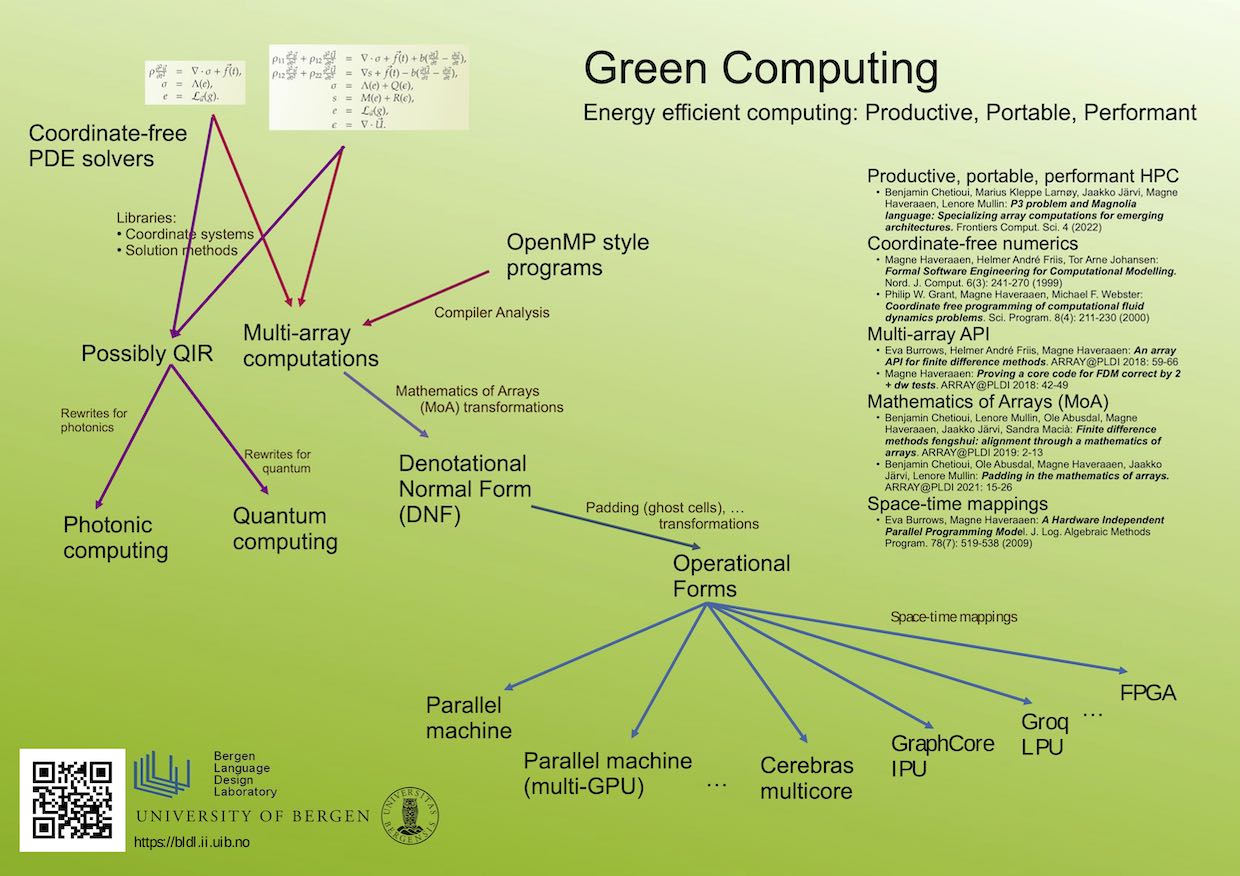
Our research is on automating the steps that take a high level PDE down to target machine specific executables. We are considering digital computing, where the multi-array plays a focal point for the mapping onto the target computer's specifics (cores, caches etc). We are also looking into photonics and quantum computing, which demand very different transformations towards their computing devices).
Some relevant publications.
-
The P3 problem
- Benjamin Chetioui, Marius Kleppe Larnøy, Jaakko Järvi, Magne Haveraaen, Lenore Mullin: P3 problem and Magnolia language: Specializing array computations for emerging architectures. Frontiers Comput. Sci. 4 (2022)
-
Coordinate-free numerics
- Magne Haveraaen, Helmer André Friis, Tor Arne Johansen: Formal Software Engineering for Computational Modelling. Nord. J. Comput. 6(3): 241-270 (1999)
- Philip W. Grant, Magne Haveraaen, Michael F. Webster: Coordinate free programming of computational fluid dynamics problems. Sci. Program. 8(4): 211-230 (2000)
-
Multi-array API
- Eva Burrows, Helmer André Friis, Magne Haveraaen: An array API for finite difference methods. ARRAY@PLDI 2018: 59-66
- Magne Haveraaen: Proving a core code for FDM correct by 2 + dw tests. ARRAY@PLDI 2018: 42-49
-
Mathematics of Arrays (MoA)
- Benjamin Chetioui, Lenore Mullin, Ole Abusdal, Magne Haveraaen, Jaakko Järvi, Sandra Macià: Finite difference methods fengshui: alignment through a mathematics of arrays. ARRAY@PLDI 2019: 2-13
- Benjamin Chetioui, Ole Abusdal, Magne Haveraaen, Jaakko Järvi, Lenore Mullin: Padding in the mathematics of arrays. ARRAY@PLDI 2021: 15-26
-
Space-time mappings
- Eva Burrows, Magne Haveraaen: A Hardware Independent Parallel Programming Model. J. Log. Algebraic Methods Program. 78(7): 519-538 (2009)
GraphBLAS and Fortran templates
GraphBLAS is about defining the standard building blocks for graph algorithms in the language of linear algebra. It is handled by the GraphBLAS forum.
This poster presents the result of a student project where the assignment was to provide a prototype implementation of GraphBLAS using the generic features of Fortran 2028 – the next Fortran standard.
- The template extension to Fortran has passed the ISO committee draft (CD) stage. The next step is it becoming part of the Draft international standard (DIS), which should happen at the ISO Fortran standards meeting in Bergen (Norway) in June 2027.
- The LFortran compiler has a prototype implementation of Fortran templates which is sufficient to compile and run the students' GraphBLAS code.
- GraphBLAS is a good match for a template mechanism, especially a type-safe template mechanism like that of templates in Fortran. The basic assumption is that matrix operations require the operations of a semiring, i.e., multiplication and addition and their normal properties. By varying the interpretation of what the semiring is, many distinct graph algorithms utilise the matrix operations in the same way. This gives a significant reuse of the code, with significant implementation and testing benefits.
- The students have written a report on their work.
Green Data Centre: A Nordic case study
This is sketching out a project looking into specific characteristics of running a data centre in the nordic regions.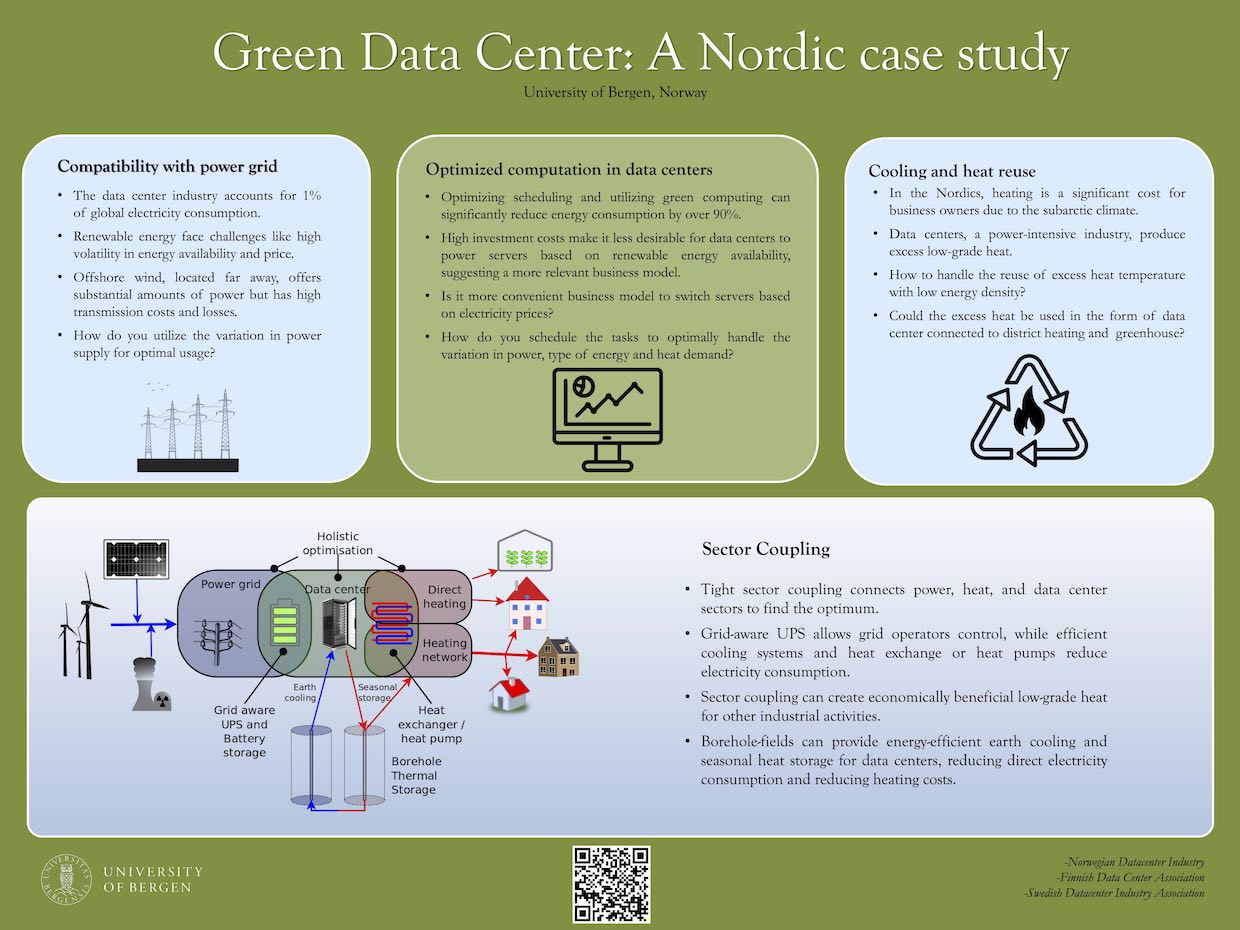
Application of ∆Q timeliness analysis on public transport data in Norway
This is not a supercomputing project, but it utilises large data sets and treats statistical data distributions as intrinsic semantics — a promising basis for other domains like quantum computing.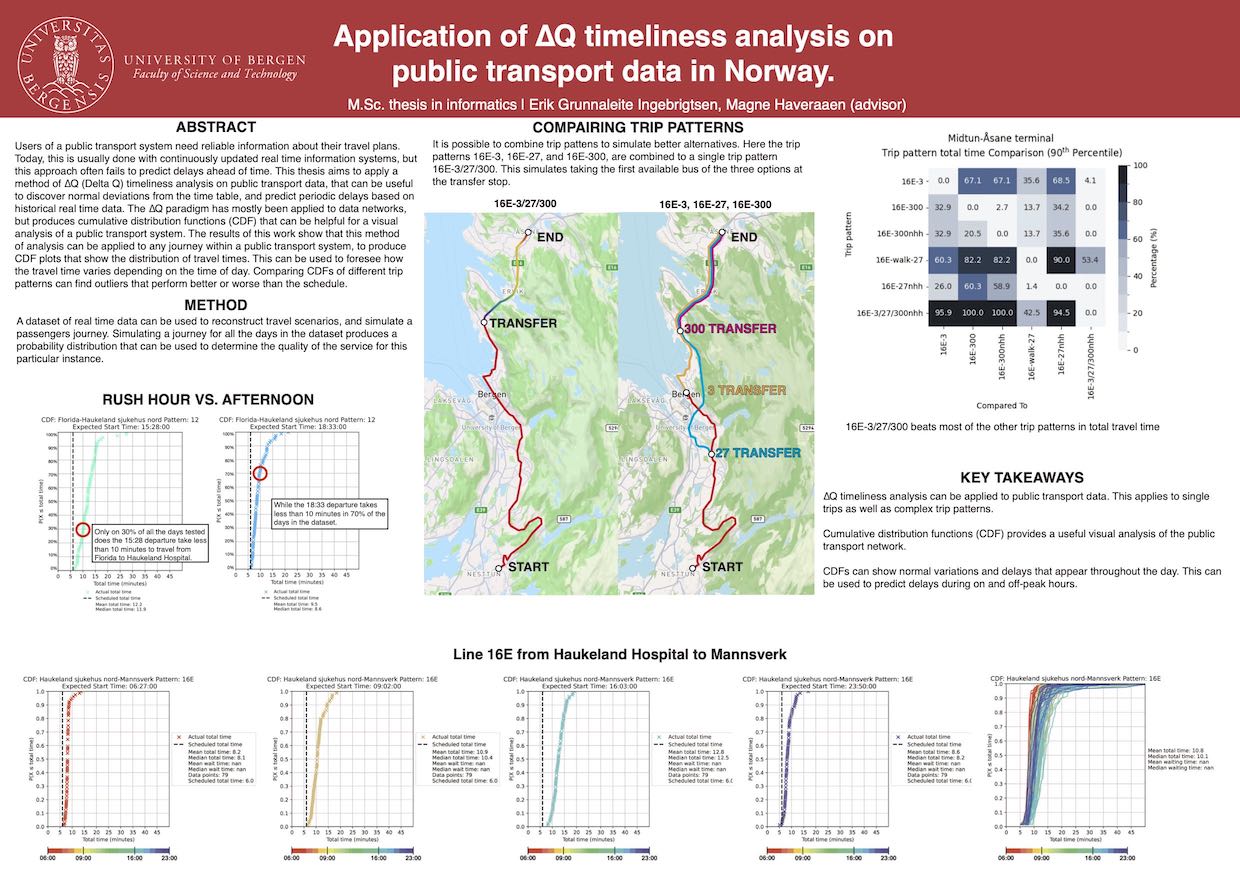
The ∆Q (quality attenuation) Systems Development (∆QSD) approach was developed by the UK company PNSol. They have mostly applied it to timeliness analysis of packet networks, such as in the telecom domain. Extending timeliness analysis to the passenger perspective of public transport adds another dimension.
The work was carried out by master student Erik Grunnaleite Ingebrigtsen by annalysing 6 months of high resultion data for parts of the bus network in Bergen. Clear patterns for delays throughout the data and across bus stops emerged, as well as the ability to analyse the passenger experience when a bus journey crosses multiple bus routes.
- A web page describing the work and some results, with links to his thesis.
- Seyed Hossein Haeri, Peter Van Roy, Heinrich Apfelmus, Peter W. Thompson, Neil J. Davies, Magne Haveraaen, Mikhail Barash, Kevin Hammond, James Chapman, Artjoms Šinkarovs: Algebraic reasoning for timeliness-guided system design, Journal of Logical and Algebraic Methods in Programming, Volume 148, 2026, 101093, ISSN 2352-2208